How to Measure Ring Size
Published by Ring Sizer · App developer: Pawel Boguta · Updated
To measure your ring size, find the inner diameter or inner circumference of a ring that already fits, then match that measurement to a ring size chart. A US size 7 ring, for example, has an inner diameter of about 17.3 mm and an inner circumference of about 54 mm. You have three reliable ways to get that measurement at home: measure a ring you already own, wrap a strip of paper or string around your finger, or use an on-screen sizer that calibrates to your phone. This guide walks through all three, shows you how to read the result in US, UK, EU, and other systems, and flags the mistakes that lead to a ring that spins or pinches.
This guide is for anyone buying a ring without a jeweler nearby: a surprise proposal, an online order, or a gift where you cannot ask the wearer directly.
Key takeaways
- Ring size is set by inner circumference (or diameter), not the look of the band.
- The most accurate home method is measuring a ring that already fits the right finger.
- Measure at the end of the day, when fingers are at their largest, and never when cold.
- A US 7 is roughly 17.3 mm across; each full US size is about 0.8 mm of diameter.
- For a final purchase, confirm a borderline result with a jeweler.
What “ring size” actually measures
Ring size is a single number derived from the inner circumference of the band, measured in millimeters. Different countries label that same circumference differently. The EU/ISO system (ISO 8653) uses the circumference in millimeters directly, so EU 54 means a 54 mm inner circumference. The US system uses numbers, the UK and Australia use letters, and the Japanese reference uses another numeric scale. Conversions are approximate because size labels are rounded and retailer conventions can differ.
Two practical consequences:
- You only need one good measurement. Get the diameter or circumference once and the rest is conversion.
- Band width changes the fit. A wide band sits tighter on the same finger, so size up a quarter to half size for bands wider than about 6 mm.
Method 1, measure a ring that already fits (most accurate)
If the wearer already owns a ring that fits the intended finger, this is the most accurate method because you are measuring a real, worn fit.
Inner diameter
- Lay the ring flat on a ruler with millimeter marks.
- Measure straight across the inside, edge to edge, through the center.
- Read the inner diameter in millimeters.
Convert diameter to size
Match the diameter to the chart. As a reference, 16.5 mm is about a US 6, 17.3 mm is about a US 7, and 18.1 mm is about a US 8. Each full US size adds roughly 0.81 mm of diameter, so even a 0.4 mm reading error can push you half a size off. Measure twice.
17.3 mm diameter is about US 7, UK N 1/2, EU 54.
Thin band chart size, with no fit adjustment.
Converted sizes
- US / Canada
- 7
- UK / Australia
- N 1/2
- EU / ISO
- 54
- Japan
- 14
- India
- 14
- Diameter
- 17.3 mm
- Circumference (mm)
- 54.3 mm
- Circumference (in)
- 2.140 in
Uses the Ring Sizer conversion model. Measured values and nominal size conversions can round differently. Use thin band for a chart conversion. See our methodology and supported ranges.
Method 2, the string or paper method
No spare ring? Wrap the finger instead. This is the classic at-home approach and needs only a strip of paper or a piece of string.
- Cut a strip of paper about 6 mm wide, or use a length of string.
- Wrap it snugly around the base of the finger, where the ring will sit.
- Mark where the strip overlaps.
- Lay it flat and measure the length to the mark in millimeters. That length is your inner circumference.
A US 7 is about 54 mm of circumference, a US 8 about 57 mm. Pull the strip snug but not tight, and check that it slides over the knuckle, since the knuckle is usually wider than the base.
The full step-by-step, including a printable strip and common mistakes, lives on the how to measure ring size at home page.
Method 3, on-screen measurement
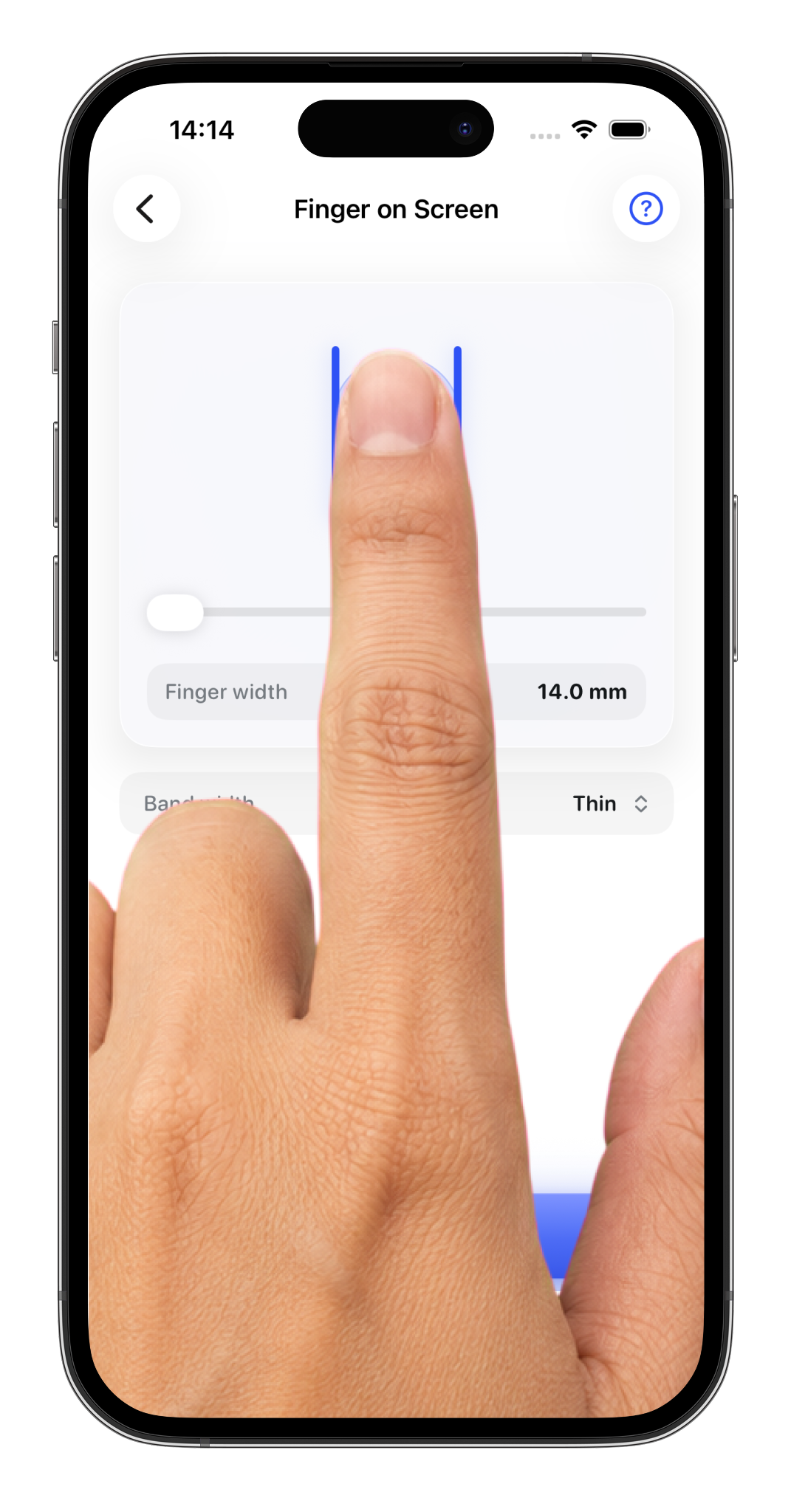
If you have a phone, you can skip the ruler. The Ring Sizer app measures on screen: place an existing ring on the display and resize an on-screen circle to match, or place your finger directly on the screen. The app calibrates to your exact phone model and screen size, using your device's pixel density automatically rather than a guess. It then shows your size in every system at once and lets you adjust for band width.
Reading your size in every system
Once you have a measurement, here is how one size looks across the major systems. These rows are computed by the same engine the app uses.
| US | Inner diameter | Inner circumference | UK | EU / ISO | Japan |
|---|---|---|---|---|---|
| 6 | 16.5 mm | 51.9 mm | L 1/2 | 52 | 12 |
| 7 | 17.3 mm | 54.4 mm | N 1/2 | 54 | 14 |
| 8 | 18.1 mm | 57.0 mm | P 1/2 | 57 | 17 |
| 9 | 18.9 mm | 59.5 mm | R 1/2 | 60 | 19 |
| 10 | 19.8 mm | 62.1 mm | T 1/2 | 62 | 22 |
For the complete chart with every half size and more countries, see the ring size chart.
When to measure for the most accurate result
- Measure at the end of the day. Fingers swell slightly and are at their largest.
- Avoid measuring when cold or just after exercise, when fingers shrink or swell abnormally.
- Measure the actual finger the ring will go on. Dominant hands tend to run slightly larger.
- Account for knuckles. If the knuckle is much wider than the base, size to slide over the knuckle, then expect a little movement at the base.
Average ring sizes (a sanity check, not a substitute)
Retail purchase patterns can offer context, but cannot determine a person's fit. See our sourced guide to commonly purchased sizes and confirm the intended finger's measurement before ordering.
FAQ
How can I measure my ring size without any tools?
Wrap a strip of paper or string around the base of your finger, mark the overlap, and measure the length in millimeters. That length is your inner circumference. About 54 mm is a US 7. The on-screen sizer needs no ruler at all.
Is ring size based on diameter or circumference?
Both describe the same band. Circumference is the distance around the inside; diameter is the distance straight across. The EU/ISO system uses circumference in millimeters directly. Our converter accepts either.
How accurate does the measurement need to be?
Within about 0.4 mm of diameter, since each full US size is roughly 0.81 mm. Measure twice and take the larger reading if you are between sizes, because a slightly loose ring beats one that will not pass the knuckle.
Does band width change my ring size?
Yes. Wider bands sit tighter on the same finger. For a band wider than about 6 mm, size up a quarter to half size.
How do I know my ring size?
Measure the inner diameter or circumference of a ring that already fits the right finger, or wrap a strip of paper around the finger and measure the length in millimeters, then match it to a ring size chart. If you have your phone, the on-screen sizer reads your size directly with no ruler.
Can I measure my ring size with a tape measure?
Yes. Use a flexible cloth or sewing tape, wrap it snugly around the base of the finger, and read the millimeters where it overlaps. That number is your inner circumference, and about 54 mm is a US 7. A rigid tape works too if you mark a paper strip and lay it flat against the tape.
How do I measure ring size in centimeters?
Measure the inner circumference in centimeters, then multiply by 10 to get millimeters, since most charts are in mm. A US 7 is about 5.4 cm around and a US 8 about 5.7 cm. The converter accepts cm, mm, and inches directly.
Measure on screen in seconds
Measuring your ring size at home takes a ruler, a strip of paper, or just your phone. Get one clean millimeter reading, convert it with the chart, and confirm a borderline size with a jeweler before a final order.
GIA explains the limitations of string measurements and the importance of knuckle and band fit.
Sources and methodology
Read our conversion rules, supported ranges, and measurement limitations.
Get your exact size, without the jeweler
Charts and paper strips get you close. To measure your real size right on screen and read it in every system at once, the most accurate option short of a trip to the jeweler, use the Ring Sizer app, free to download with in-app purchases.
 Download Ring Sizer
- Free download · In-app purchases
- iOS
- No sign-up
- Works offline